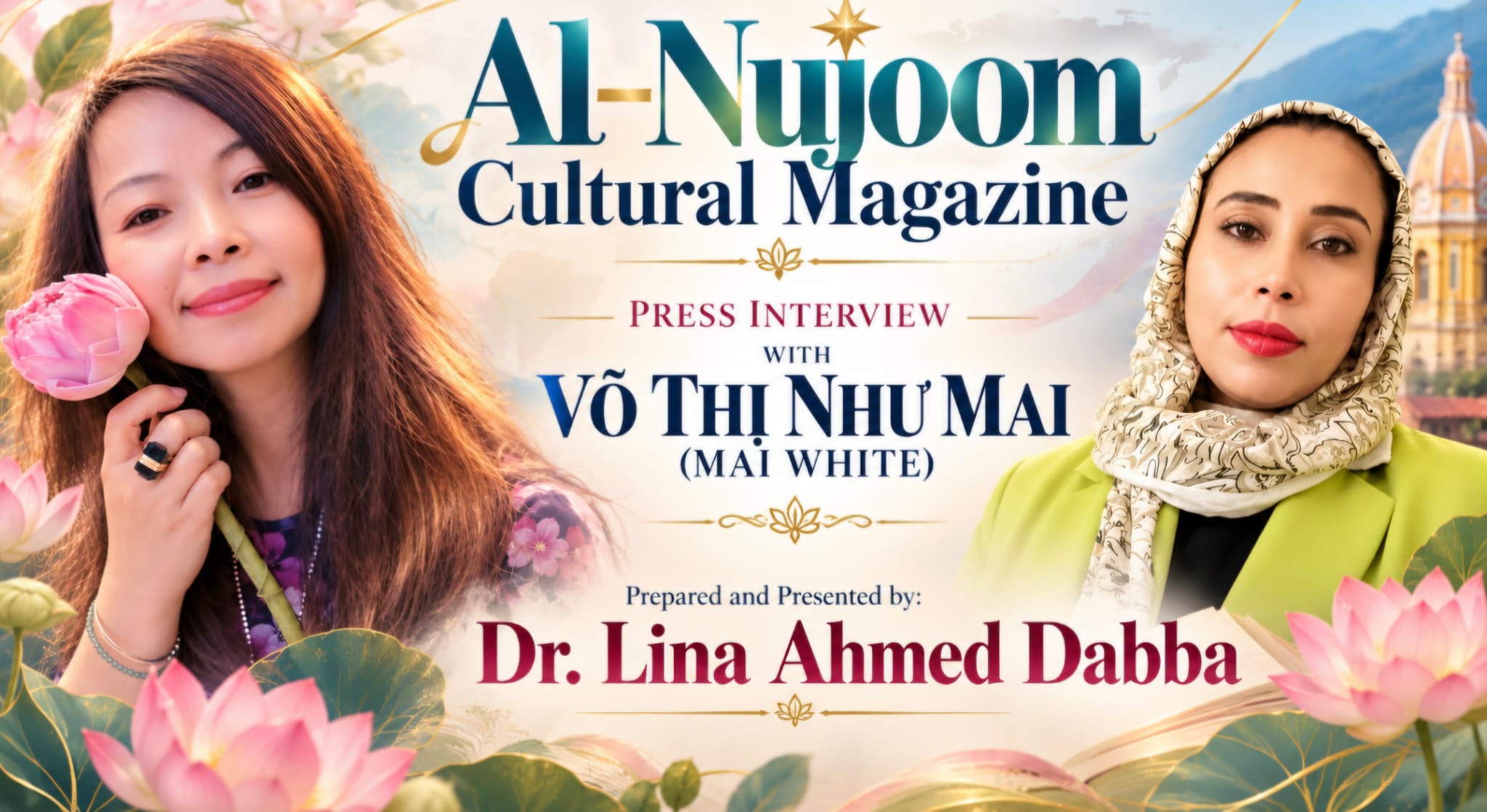
Words Build Bridges Between Peoples: Vo Thi Nhu Mai in Conversation with Al-Nujoom Cultural Magazine
PRESS & INTERNATIONAL RECOGNITION
Words Build Bridges Between Peoples
Al-Nujoom Cultural Magazine · Guest of Issue No. 7
Press interview with Vo Thi Nhu Mai (Mai White)
Prepared and conducted by Dr. Lina Ahmed Dabba, Editor-in-Chief, Al-Nujoom Cultural Magazine.
Introduction
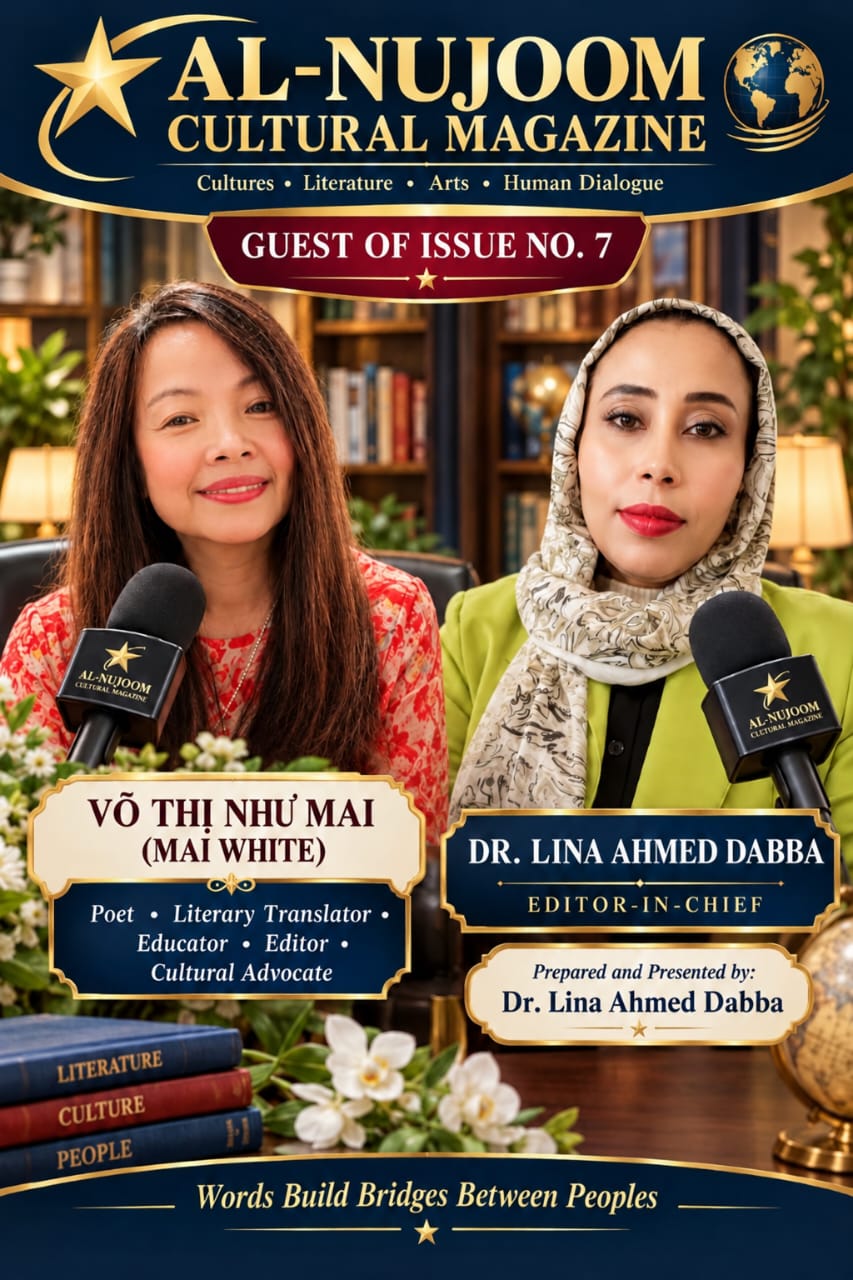
In this special interview, we welcome Vo Thi Nhu Mai, widely known by her literary name Mai White, a Vietnamese-born poet, literary translator, educator, editor, and cultural advocate based in Western Australia.
Through her poetry and translation, she builds connections between languages, cultures, and communities. As the founder and editor of The Rhythm of Vietnam, she has dedicated herself to promoting Vietnamese literature internationally while creating opportunities for writers from diverse backgrounds to share their voices.
With a professional background in education, a deep commitment to literature, and an active role in international literary networks, Mai White represents the power of words to preserve cultural identity, foster friendship, and unite people across borders.
In this conversation, she reflects on her beginnings, significant achievements, challenges, and aspirations for the future of multicultural literature.
Part I · The Voice Behind the Words
Q1. To begin, welcome to our magazine. How would you introduce yourself to our readers?
Vo Thi Nhu Mai:
Thank you, Dr. Lina Ahmed Dabba, and thank you to Al-Nujoom Cultural Magazine for this opportunity.
My name is Mai White and I write under the literary name Vo Thi Nhu Mai. I was born in Dalat, Vietnam, and now live in Perth, Western Australia.
I am a poet, literary translator, educator, editor, and cultural advocate. Teaching has been an important part of my life for 25 years, while poetry and translation have allowed me to explore the deeper connections between people, languages, and cultures.
I founded The Rhythm of Vietnam in 2005, a bilingual literary platform dedicated to Vietnamese literature and international cultural exchange. Through this work, I have collaborated with poets, writers, translators, and cultural organisations from different countries.
I also contribute to Multicultural Press Australia and serve as Continental Coordinator for Oceania with the World Poetry Movement. My literary activities have taken me to international gatherings. Poetry becomes a meeting place for people who may speak different languages but share similar hopes and emotions.
Above all, I see myself as someone who believes in the power of words. I believe literature can preserve our memories, honour our origin, and help us recognise our shared humanity.
Q2. How did your journey in this field begin, and what motivated you to choose this path?
Vo Thi Nhu Mai:
My relationship with literature began in childhood, long before I imagined that poetry might become an international part of my life.
My mother told stories at night, introducing me to the beauty of words and the wisdom hidden in ordinary experiences. My father gave me a collection of poems by the Vietnamese poet Xuan Quynh, a gift that deepened my love for poetry. I also enjoyed copying poems and spending time with Vietnamese literature.
These early experiences taught me that literature is not simply about beautiful language. It is about memory, emotion, family, and the human experience.
I initially pursued English teaching, working in Vietnam before continuing my teaching career in Australia. Education taught me patience, discipline, and the importance of helping others discover their own voices.
After moving to Australia, I began to understand literature in a different way. When we live away from our birthplace, language becomes more than a means of communication. It becomes a home we can carry within ourselves.
That understanding strengthened my desire to preserve Vietnamese literature while introducing it to international readers. Translation became a natural extension of my poetry, and The Rhythm of Vietnam grew from my wish to connect writers and readers across cultural boundaries.
I began with a love of words. One poem led to another, one friendship led to another, and gradually, literature opened doors to the world.
Part II · A Journey Across Cultures
Q3. What are the most important milestones that have shaped your personality and professional career?
Vo Thi Nhu Mai:
Several milestones have shaped the person I am today. The first was becoming an educator. Teaching for more than two decades has helped me understand the importance of communication, cultural sensitivity, and lifelong learning. Working with children has also reminded me that every individual has a story worth hearing.
The second was establishing The Rhythm of Vietnam. Building a literary platform has allowed me to bring together Vietnamese writers at home and abroad, introduce international poets to Vietnamese readers, and develop bilingual publications that preserve our literary heritage.
Among the projects close to my heart are THE GRACEFUL FOLD OF TIME, a collection bringing together 264 authors, and THE RHYTHMOFVIETNAM, an anthology featuring 500 poems by 307 authors. Each project distributed 500 copies. These projects represent collective portraits of a literary community, preserving diverse voices for future generations.
Another important milestone has been my work as a literary translator. Translating poetry requires much more than finding equivalent words. It involves listening to the rhythm, understanding the cultural background, and trying to carry the emotional truth of a poem into another language.
International literary festivals have also transformed my perspective. Participating in poetry events and cultural exchanges in countries including Indonesia, South Korea, Türkiye, Colombia, Thailand, Greece, India, Japan, Colombia, France, Indonesia and China has shown me how literature can build friendships beyond geographical and linguistic boundaries.
Recognition has encouraged me along the way. In May 2025, I received recognition from Vietnam’s diplomatic representation in Australia for my contribution to Vietnamese language and cultural promotion. In 2026, I was honoured with a Special Prize in the Naji Naaman Literary Prizes.
I appreciate these acknowledgements, but I measure my work through the books that reach readers, the writers who find an opportunity to be heard, and the friendships that continue long after a literary event ends.
Q4. Did you face any challenges or difficulties at the beginning of your journey? How did you overcome them?
Vo Thi Nhu Mai:
Yes. Every meaningful journey contains difficulties, and mine has required persistence, patience, and faith in the value of the work.
One of my greatest challenges has been balancing the responsibilities of a full-time teaching career with poetry, translation, editing, and international literary collaboration. These activities require time, concentration, and emotional energy. Much of my literary work takes place outside school hours, often in the evenings and on weekends.
Living between cultures has presented another challenge. I embrace Vietnam within my language, memories, and literary sensibility, while Australia is the place where I live and contribute to my community. Bringing these worlds together is beautiful, but it also requires constant learning and adaptation.
Translation presents its own difficulties. A poem may contain cultural references, musical qualities, or emotional nuances that cannot be transferred directly into another language. I have learned that a translator must be both humble and creative, respecting the original poet while finding a natural voice for readers in the new language.
There are also practical challenges in independent literary publishing. Connecting contributors, editing manuscripts, preparing bilingual material, communicating across time zones, and bringing publications to readers all require sustained effort.
I have overcome these challenges by remaining committed to my purpose, working with people who share similar values, and taking each project one step at a time.
I have also learned that progress does not always need to be dramatic. Sometimes, it is simply the decision to continue when the work is difficult and the results are not immediately visible.
Part III · The People and Purpose Behind the Poetry
Q5. What achievement are you most proud of, and why?
Vo Thi Nhu Mai:
If I had to choose one achievement, I would choose the community I have helped build through The Rhythm of Vietnam.
Awards are meaningful, books are tangible, and international invitations are wonderful opportunities. However, what touches me most is seeing writers from different backgrounds come together through literature.
Through The Rhythm of Vietnam, I have worked to give Vietnamese poetry a wider audience and to create opportunities for writers to encounter one another across languages and borders. Our bilingual publications help preserve Vietnamese voices while making their work more accessible to international readers.
I am also proud of my translation work, which brings Vietnamese literature to English-speaking readers and introduces international literature to Vietnamese audiences. Every successful translation creates a new possibility for understanding.
My recognition for cultural contribution in Australia and the international literary honours I have received are deeply encouraging. They remind me that work often carried out quietly, far from the spotlight, can have meaning beyond one’s immediate community.
I am proudest when literature creates a connection that would not otherwise have existed.
A poem may begin in one person’s private experience, but once it reaches another reader, it becomes part of a shared human story. Helping that happen is one of the greatest privileges of my life.
Q6. Who are the people who have had the greatest influence on your journey?
Vo Thi Nhu Mai:
My parents were my first teachers in the world of stories and emotions. My mother nurtured my imagination through the stories she told, while my father encouraged my love of poetry by giving me Xuan Quynh’s poems. Their influence remains with me, even as my life and work have taken me far from my birthplace.
The Vietnamese literary tradition has also shaped me profoundly. The poets and writers whose works I read taught me that literature can be intimate and universal at the same time. A poem in a particular landscape or culture can still speak to someone living on the other side of the world.
My students have influenced me, too. Working in education reminds me that learning is never one-directional. Children continually teach us about curiosity, honesty, imagination, and the courage to begin again.
I am equally grateful to the poets, translators, editors, festival organisers, and cultural advocates I have met internationally. Each collaboration has expanded my understanding of literature and reminded me that no writer works entirely alone.
I would not want to name only a few individuals when so many people have contributed to my development. Some have offered encouragement, some have shared their work, and others have opened doors to new literary communities.
Their influence has helped me understand that success is rarely an individual achievement. Behind every meaningful publication or international collaboration, there are many people who contribute their time, trust, knowledge, and generosity.
Part IV · Literature Without Borders
Q7. How do you view the current state of your field, and what are the main challenges it faces today?
Vo Thi Nhu Mai:
I see international literature as a field full of possibility, but also one that requires greater attention to diversity, accessibility, and meaningful cultural exchange.
Today, technology allows poets and translators to communicate across continents almost instantly. Independent literary platforms, online readings, digital publications, and international festivals have created opportunities that were much more difficult to access in the past.
Writers no longer need to wait for traditional publishing institutions to discover them before they can begin building international relationships. A poem written in Vietnam can reach a reader in Australia, Africa, Europe, or the Americas within minutes.
However, accessibility does not automatically mean visibility. Many talented writers working in less widely spoken languages struggle to reach international audiences. Translation opportunities and publishing resources are not equally distributed, and literary recognition can still depend on language, geography, institutional networks, and financial capacity.
Another challenge is preserving the integrity of literary translation in an age of artificial intelligence. Technology can assist with certain tasks, but poetry carries cultural memory, ambiguity, rhythm, and emotional subtleties that require human sensitivity. I believe technological tools should support translators rather than replace the thoughtful engagement that makes literary translation meaningful.
Independent cultural initiatives also need sustainable support. Much of the work involved in editing, translating, mentoring, and organising literary exchanges is undertaken through personal commitment and voluntary effort.
My vision is for a more inclusive literary world in which writers are valued for the depth and originality of their work, rather than being limited by the language they speak or the country in which they live.
I believe multicultural literature can contribute to a more compassionate world. When we read the stories of people whose lives differ from ours, we begin to see beyond stereotypes and discover the human experiences we share.
Q8. What are your ambitions and upcoming projects for the next stage?
Vo Thi Nhu Mai:
My ambitions are closely connected to what I have already been building: a stronger international platform for literature, translation, and cultural collaboration.
One of my major goals is to develop The Rhythm of Vietnam further as a bilingual literary and cultural platform, connecting Vietnamese writers at home and abroad with readers and literary communities around the world.
I also hope to expand the work of Multicultural Press Australia, creating more opportunities to document multicultural literary activities, introduce emerging voices, and showcase the contributions of writers from diverse communities.
Publishing is another important ambition. I would like to establish a more sustainable publishing presence in Perth that can help bring Vietnamese and international literature to wider audiences. In the longer term, I hope to develop a space that combines publishing, bookselling, cultural events, and literary conversation.
I am particularly interested in bilingual and multilingual anthologies, because they allow different literary traditions to meet without losing their individual identities. My work with international poets and translators has reinforced my belief that collaboration can create something greater than any single participant could achieve alone.
I also intend to continue participating in international poetry festivals and cultural initiatives, including projects that use poetry to promote peace, solidarity, and mutual understanding.
An important upcoming event is the International Translation Day Award planned for 27 January 2027 in Ho Chi Minh City. I hope it will provide an opportunity to celebrate translators and recognise the essential role they play in bringing literature across linguistic boundaries.
I will also continue developing projects through The Rhythm of Vietnam, including the Friendship, Music and Poetry Rendezvous planned for Ho Chi Minh City on 3 January 2027.
My ambitions are not simply about publishing more books or attending more festivals. They are about creating lasting connections, supporting other writers, and helping literature travel further than any of us can travel alone.
Part V · Words for the Next Generation
Q9. What message would you like to share with young people who dream of succeeding in the same field?
Vo Thi Nhu Mai:
My message to young poets, writers, translators, and cultural advocates is simple: begin with sincerity, remain curious, and do not be afraid to grow slowly.
Read widely, including writers whose experiences and perspectives differ from your own. Learn your language deeply, and if you wish to translate, respect both the original text and the readers who will encounter it in another language.
Do not measure your worth only by awards, publication opportunities, or the number of people who recognise your name. These things may come, but they should not become the only reasons you create.
Develop discipline. Inspiration is important, but meaningful work also requires revision, patience, and the willingness to learn from criticism. Build relationships with people who respect your work and who are willing to share knowledge and opportunities.
I would also encourage young writers to remain connected to their cultural roots while staying open to the world. You do not need to abandon your identity to communicate internationally. Often, the more honestly you understand your own culture, the more meaningfully you can connect with others.
Most importantly, do not believe that your voice is too small to matter. A poem may reach only one reader today, but that reader may carry its meaning for many years.
You may not change the whole world through a single poem. But you may change the way one person sees another human being. That is already a meaningful beginning.
Q10. Finally, what would you like to say to the readers of Al-Nujoom Cultural Magazine?
Vo Thi Nhu Mai:
I would like to express my sincere gratitude to Dr. Lina Ahmed Dabba and the editorial team of Al-Nujoom Cultural Magazine for inviting me to share my story.
I believe every culture carries treasures that deserve to be discovered, and every language contains ways of understanding the world that can enrich others. Literature gives us an opportunity to encounter these treasures through the voices of poets, storytellers, and translators.
As someone born in Vietnam and living in Australia, I have come to understand that belonging does not have to be limited to one place. We can love our birthplace while embracing the country where we live. We can preserve our mother tongue while learning to listen to other languages. We can remain faithful to our roots while allowing our branches to reach across the world.
I hope readers will continue to explore literature beyond their own linguistic and cultural boundaries. Read a poem from another country. Listen to a writer whose experiences differ from yours. Support translators who help stories travel between languages.
My wish is that we continue to build a world in which poetry is not merely something we read, but also something that helps us live with greater empathy, dignity, and understanding.
Thank you for welcoming my voice into your magazine. May our words continue to build bridges of friendship between Vietnam, Australia, and the wider world.
Closing Editorial Note
At the end of this special interview, Al-Nujoom Cultural Magazine extends its sincere thanks to Vo Thi Nhu Mai (Mai White) for sharing her experiences, reflections, and vision.
Her work as a poet, literary translator, educator, editor, and cultural advocate demonstrates how literature can preserve cultural heritage while creating meaningful connections across borders. Through The Rhythm of Vietnam and her international literary collaborations, she continues to contribute to a more connected and culturally inclusive literary community.
We wish Mai White continued inspiration, success, and fulfilment in her literary and educational endeavours, and every success in her future projects promoting poetry, translation, friendship, and cultural understanding.
Press Interview | Al-Nujoom Cultural Magazine
Prepared and Conducted by: Dr. Lina Ahmed Dabba
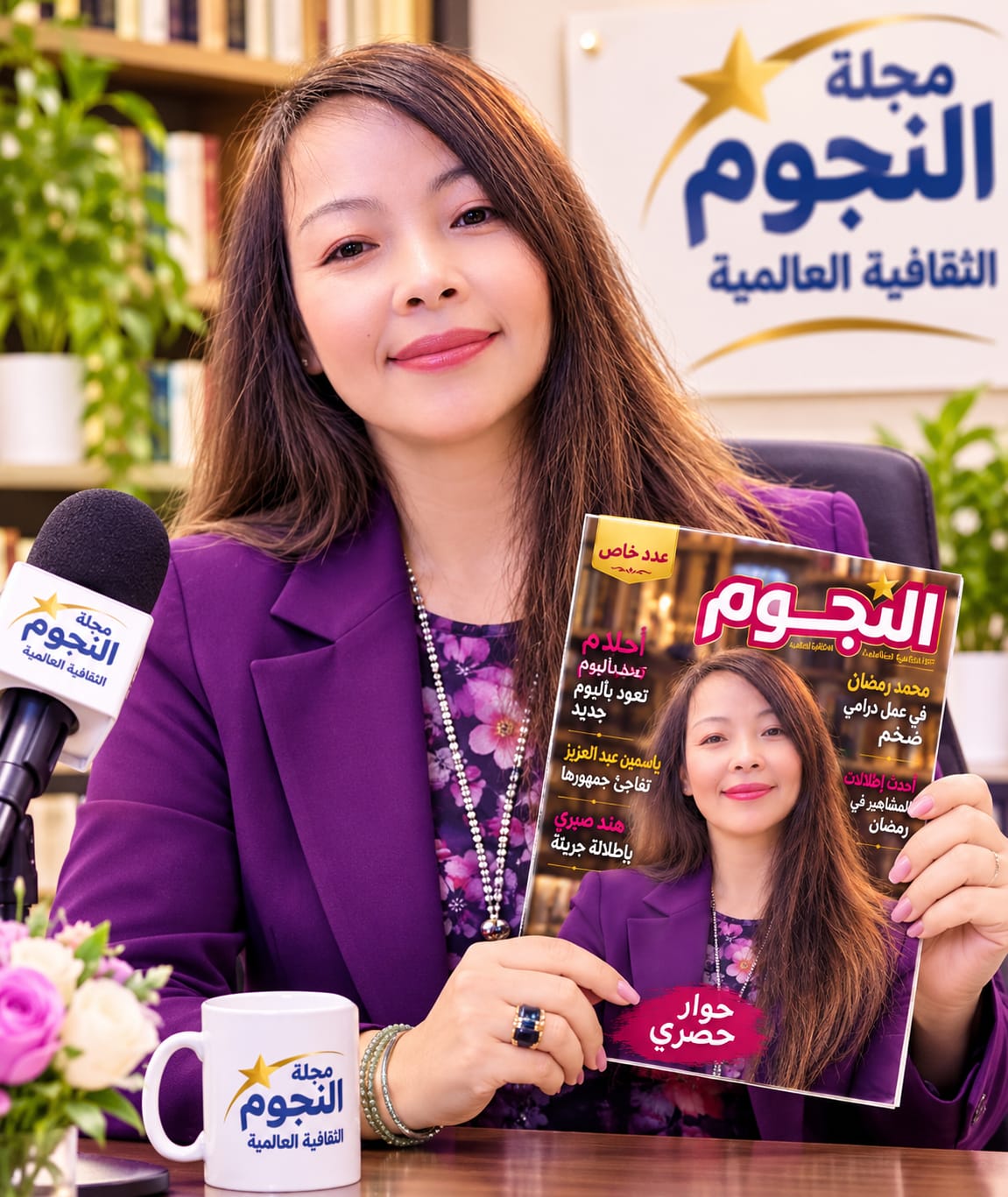
Inside Al-Nujoom Cultural Magazine, Issue No. 7
Explore the accompanying promotional video showcasing the magazine issue featuring Vo Thi Nhu Mai (Mai White), its editorial artwork and literary content. This video presents the magazine rather than a recording of the ten-question interview.
Interview Credit
Press Interview | Al-Nujoom Cultural Magazine. Prepared and conducted by Dr. Lina Ahmed Dabba.
Read more about Mai’s international activities on the Events & Festivals page.